With Microsoft Windows 7
about to launch and a new DirectX
just around the corner, ATI and NVIDIA have prepared for the final
showdown of the DirectX 10 era. Both companies have readied what are currently the fastest and
most fully-featured DirectX 10 videocards, and PCSTATS is here to place them head to
head. If you're
a regular reader of PCSTATS, you're likely already familiar with the Radeon HD 4890. Based on the ATI Radeon RV790 GPU. ATI
took its
previous flagship videocard, the Radeon HD 4870, and ramped clock speeds up while opening
up even more headroom for overclocking. The result is one of the
best videocards in the high end market, with a fantastic performance to price ratio. But
this you know already.
NVIDIA
has been sidelined by ATI for a while now, but that hasn't stopped
its engineers from going back to the lab and coming
out with a single-GPU flagship videocard called the Geforce GTX 280. It's
cores were overclocked, memory speeds were increased and shaders were pushed to their
very limits. The result... the Geforce GTX 285, and NVIDIA is claiming it's the
ultimate DirectX 10 videocard.
Well,
that was before Gigabyte
got its hands on a couple GTX 285's and decided to push
them even further,
creating the Gigabyte GV-N285OC-2GI videocard. While the stock nVidia Geforce GTX 285 has a
core clock speed of 648MHz, Gigabyte has pushed the GV-N285OC-2GI to 660MHz. Shaders have been
ramped up from 1476MHz up to 1504MHz, and the memory capacity has doubled. The
Gigabyte GV-N285OC-2GI has a staggering 2GB of GDDR3 memory running at 2400MHz! The Gigabyte
GV-N285OC-2GI is a beast of a videocard, designed to not only compete with
the Radeon HD 4890, but crush it outright. Cry havoc and let slip
the dogs of war, indeed.
 |
|
Gigabyte GV-N285OC-2GI
Videocard
|
|
 |
|
|
|
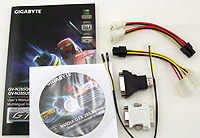
INCLUDES: User's
Manual, Driver CD, DVI-to-Analog converter, DVI-to-HDMI converter, (2) SLI
6-pin-to molex power cables, S/PDIF adapter
cable. |
|
|
Graphics Processor: (1)
nVidia Geforce GTX 285 (660MHz)
Memory
Capacity: 2048MB GDDR3 (1200MHz)
Card Format: PCI Express x16 2.0, two slots
wide.
Outputs: HDMI, Analog,
DVI-D
Videocard Class: Flagship /
High End | |
| |
Everything you'd expect from a NVIDIA GT200b-based
videocard is here: NVIDIA PhysX, CUDA, Hybridpower, 3-way SLI, Purevideo and
Graphics Plus. Support for DirectX 10, OpenGL 2.1 are of course included,
although NVIDIA has stated that it will be skipping DirectX 10.1 support
altogether and instead go straight to DirectX 11 with a future graphics
processor.
The price for supreme power is often steep, and the
Gigabyte GV-N285OC-2GI videocard is not a flagship videocard you'll be finding
in the idles of Newegg for $100. Be prepared to pay around $440 CDN ($406 USD, £245 GBP) for the honour of owning a
Gigabyte GV-N285OC-2GI videocard, or to put it another way nearly double the
price of the Radeon HD 4890. In this review PCSTATS will be testing the Gigabyte
GV-N285OC-2GI to establish to critical facts. Is it the true GPU king? Does it
outperform the equivalently priced dual-GPU Radeon HD 4870 X2? Let's see how the
ultimate GPUs of this generation compare in a head to head showdown!
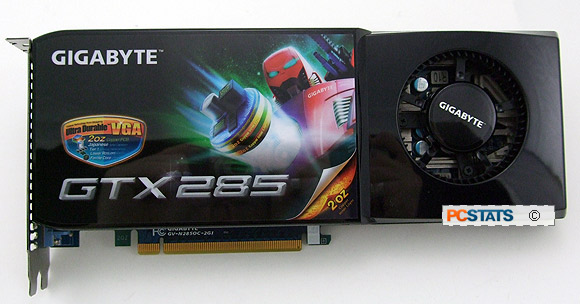
The
Gigabyte GV-N285OC-2GI videocard uses the NVIDIA reference heatsink, a design that should
be familiar to anyone who's purchased an NVIDIA Geforce videocard in the
past two or three years. The heat shroud design is two slots wide, which has
become standard for most performance videocards. The card is about the same size
as the Geforce GTX 260 (about 10.5" long), so it shouldn't be particularly
difficult to fit it inside most mid-tower desktop PCs.
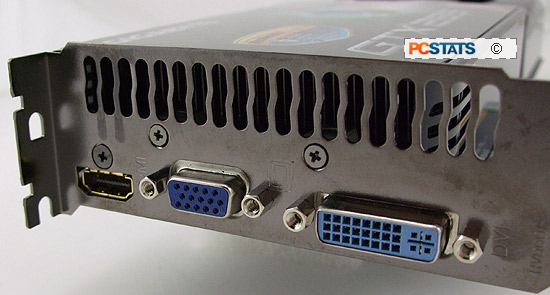
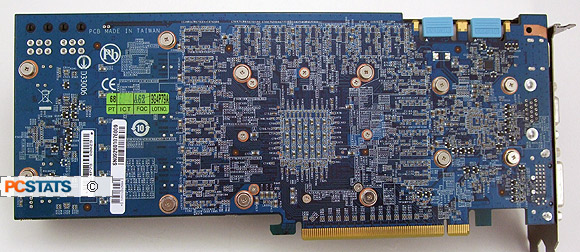
The I/O panel of the Gigabyte GV-N285OC-2GI has
the three most common videocard outputs. DVI, VGA and HDMI. It's possible to hook the
GV-N285OC-2GI up to a PC monitor or a HDTV. The DVI
can be used in conjunction with either the HDMI or VGA, depending on what kind
of signal you need. To get sound out of the the HDMI output, the use
of an included passthrough S/PDIF cable is required. The dual-link DVI and HDMI outputs are capable of
outputting 2560 x 1600 resolution, while the VGA can go as high
as 2048 x 1536.
Onboard hardware HD decoding technologies come care of
NVIDIA PureVideo, so BluRay, H.264, VC-1, MPEG2, or WMV9-encoded media can be
played back with little if any CPU load.
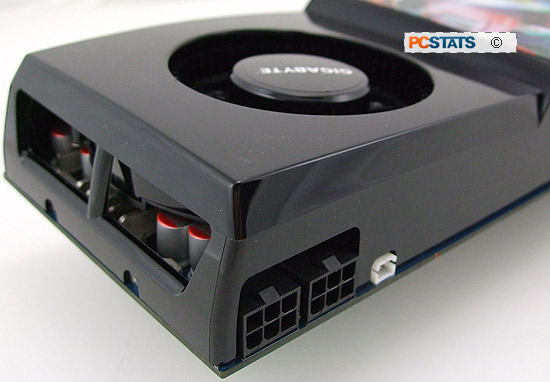
Like the Geforce GTX 260, the Gigabyte GV-N285OC-2GI has an
officially related thermal design power of 182W, so it requires two 6-pin PCI
Express power adapters. PCSTATS was quite happy to find these instead of the
8-pin PCI Express connectors found on earlier Geforce GTX 280 videocards, which
had a number of incompatibilities with current power supplies. Performance
videocards requiring multiple power connectors are pretty common, so power
supply manufacturers long ago incorporated the extra power connectors necessary.
If your power supply doesn't have the twin 6-pin SLI power connectors, there are
a pair of adapters included in the Gigabyte GV-N285OC-2GI's box, alternatively
PCSTATS recommends this 850W unit from
Seasonic.
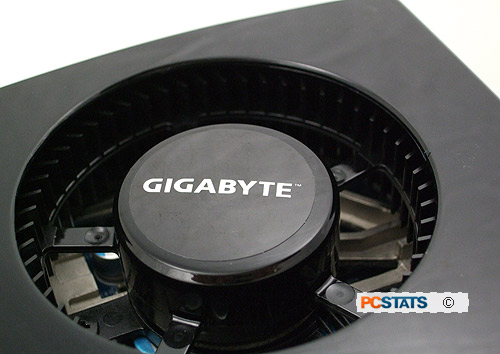
The Gigabyte GV-N285OC-2GI uses the reference Geforce GTX 285 cooler,
which has proven itself to be quite effective at keeping the
videocard cool while staying fairly quiet. The only real
drawback to this design is dust build-up, which can be a pain to
clean out without removing the heat shroud from the videocard. While we were running the Gigabyte GV-N285OC-2GI,
temperatures and noise stayed about average. The videocard isn't noticeably
noisier than the Radeon HD 4890 or the Geforce GTX 260 when running under full
load, the fan is only noticeably loud during its initial spin-up during system
booting.
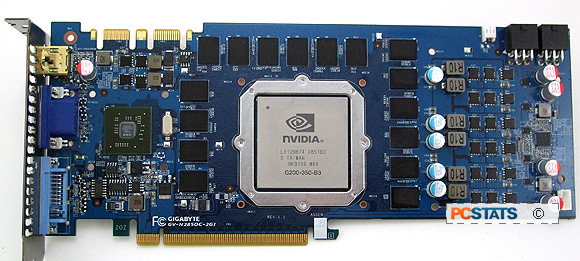
Let's take the cooler
off and take a closer look inside the NVIDIA Geforce GTX 285...






 RSS Newsletter